Showing posts with label Dance. Show all posts

Friday, 10 August 2012


Revealing the 1909-1912 Period of the Ballets Russes

  
Recently, I came across the most extraordinary footage.

It is of Ida Rubinstein acting, but more importantly dancing, in an extended way in the 1921 Italian film ‘La Nave’, which was based on Gabriele D'Annunzio's 1908 drama about the founding of Venice.

Often such legendary figures disappoint when revealed at last on film, but this is not at all the case here.

Rubinstein gives the strongest impression of the perfumed oriental Art Nouveau  exoticism of the early period Ballets Russes of 1909 to 1912.

And who better to do so. She had appeared in the title role the company’s ‘Cléopâtre’ (1909), with choreography by Mikhail Fokine and costumes and sets by Leon Bakst ... 


... and as Zobeide opposite Vaslav Nijinsky in 'Schéhérazade' (1910) with the same choreographer and designer ...


To give some sense of Rubinstein’s extraordinary impact on stage, it’s instructive to read the following notes by Jean Cocteau made on her entrance in ‘Cléopâtre’ during the first few performances of the work:

“Then a ritual cortege was seen to appear. There were musicians who plucked long, oval-shaped citharas, their tones richly resonant, yet soft as the breath of serpents. Flutists, their arms raised in angular poses, blew from their sonorous pipes spirals of sound so piercing, so sharp, ascending and descending in turn, that one’s nerves could hardly endure them. There were terra-cotta-complexioned fauns, with long white manes; narrow-hipped young women with painted elbows and flat eyes; and all the other attendants on a royal gallery.

Finally, borne on the shoulders of six colossi, there appeared a kind of ebony and gold casket, which a young black watched over diligently, touching it, clearing the way for it, urging on the bearers.

The bearers set the casket down in the middle of the temple, opened its double lid, and from within lifted a kind of mummy, a bundle of veils, which they placed upright on its ivory pattens. Then four slaves began an astonishing maneuver. They unwound the first veil, which was red, with silver lotuses and crocodiles; then the second veil, which was green with the history of the dynasties in gold filigree; then the third, which was orange with prismatic stripes; and so on until the twelfth veil, a dark blue, which, one divined, enclosed the body of a woman. Each veil was unwound in a different fashion: one called for a manage of intricately patterned steps, another for the skill needed to shell a ripe nut, another for the casualness with which one plucks the petals of a rose; the eleventh veil, in what seemed the most difficult movement, was peeled off in one piece like the bark of a eucalyptus.

The twelfth veil, dark blue, Mme Rubinstein released herself, letting it fall with a sweeping circular gesture
.
She stood, leaning forward, her shoulders slightly humped like the wings of the ibis; overcome by her long wait, having submitted in her dark coffin, as we had, to the intolerable and sublime music of her cortege, she wavered on her high pattens. She was wearing a small blue wig, from which a short golden braid hung down on either side of her face. There she stood, unswathed, eyes vacant, cheeks pale, lips parted, shoulders hunched, and as she confronted the stunned audience, she was too beautiful, like a too potent Oriental fragrance.”

Born into a wealthy Jewish family in Kharkov, or possibly St. Petersburg, Ida Rubinstein had little formal ballet training, though her skills were developed with coaching from Fokine. What she did possess was tremendous stage presence and a strong ability to act.

She made her debut in a single and private performance of Oscar Wilde's ‘Salomé’, in which she stripped naked in the course of the Dance of the Seven Veils. She was painted as this character by Valentin Serov in 1910.


She then appeared in leading roles in the Ballets Russes, such as the title in ‘Cléopâtre’ (1909) and Zobeide in 'Schéhérazade' (1910).

Leaving the Ballets Russes in 1911, this extraordinary force of nature formed her own dance company, which she funded by her own inherited wealth.


Here she commissioned a number of lavish productions, using variously Fokine as choreographer, Bakst as designer and Debussy as composer. These ballets include 'Le Martyr de Saint Sebastien' (1911) ...


... and 'Helene de Sparte' (1912) ...


 Always one to attract attention, she drew the notice of the Archbishop of Paris, who prohibited Catholics from seeing 'Le Martyr de Saint Sebastien' because the saint was played by a woman and a Jew.

In a sense, Rubinstein was to momentarily take on the creative and succès de scandale mantle of Serge de Diaghilev.

Not one to be any way checked by convention, in 1911, Rubinstein began a three-year affair with Romaine Brooks.


 Brooks painted and photographed her over this period.


During World World One, Rubinstein again was at the centre of things, converting the Carlton Hotel into a hospital for wounded Allied troops and undertaking charity performances.

After the war, she appeared in various plays, and performed in Staat's ‘Istar’ (1924) at the Paris Opera.


With Bronislava Nijinska as choreographer, Rubinstein had a company in Paris between 1928 and 1929. She commissioned ‘Boléro’ from Maurice Ravel and performed in the ballet choreographed to the music. Other commissions include Nijinska’s ‘Le Baiser de la fée’ with music by Sauguet and Leonide Massine's ‘David’ with music by Stravinsky.

Most definitely not ‘Vivir con miedo es como vivir en medias’ (‘A life lived in fear is a life half lived’)!

But let’s return to 1921 and that footage from Gabriellino D'Annunzio and Mario Roncoroni’s ‘La Nave’.

In this sequence from the film, Rubinstein in the role of Basiliola is called on to dance for the crowd. 


The choreography is in a sense a pastiche of much that this Belle Époque figure was famous for. The overall feeling is of reminiscent ‘Salome’. And the opening scene, in which she makes a strong bold arm movement, recalls Cocteau’s note about ‘Cléopâtre’ - ‘The twelfth veil, dark blue, Mme Rubinstein released herself, letting it fall with a sweeping circular gesture’.


I dare you not to enjoy Ida Rubinstein in this segment of 'La Nave'!

Saturday, 21 July 2012


One Degree of Separation – Tamara Nijinsky, An Interview


I just came across a rather interesting telephone interview conducted for the Los Angeles Times on 3rd November 1994.

It is an interview was with Tamara Nijinsky, the second daughter of famed Russian Ballets Russes dancer Vaslav Nijinsky.

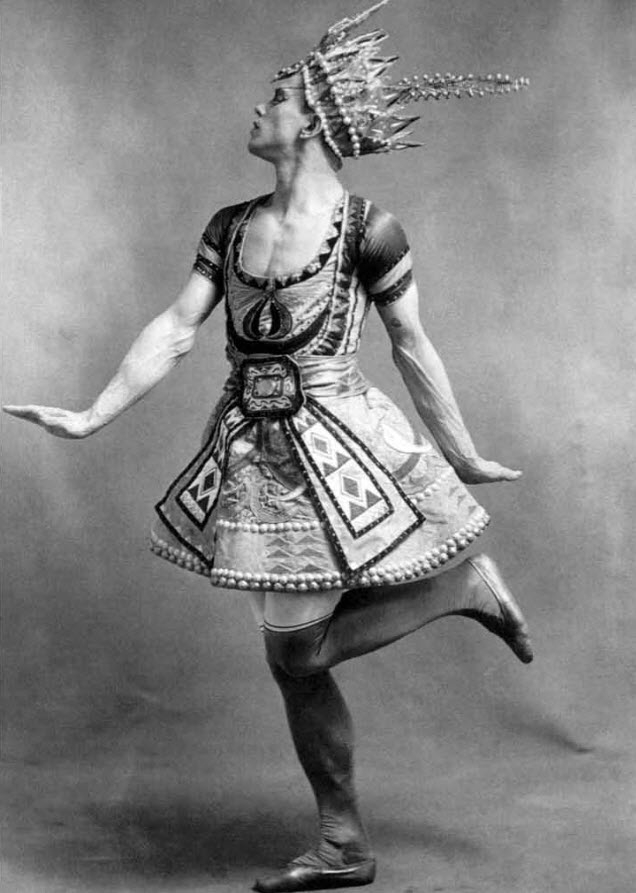
Nijinsky in 'Le Dieu Bleu' (1912)

In the interview, Tamara speaks about her father’s life after being dismissed from the Ballets Russes by its impresario, and his lover, Serge de Diaghilev, for marrying her mother, Romola de Pulszky. She speaks about the dancer’s later mental condition and particularly Peter Ostwald's ‘Vaslav Nijinsky: A Leap into Madness’ (Carol Publishing Group, 1991).

Nijinsky - Nude Sketch

Born on June 19, 1914 one year after her father was diagnosed as schizophrenia, Tamara Nijinsky never saw her father dance.


Romola Nijinsky with Kyra (left, first daughter) and Tamara (right, second daughter)


She at first lived in Paris with her parents, but then, with the family’s financial difficulties, she was sent on her twelfth birthday to live with her maternal grandmother in Budapest. She attended drama school in the Hungarian capital and became a puppeteer, moving later to the US with her husband Szakas Miklos and daughter, Kinga.

This is a transcript of the interview.

Q: What do you remember from the years you lived with your father?

A: Basically, I remember that he was a very, very quiet person. I just remember him sitting in an armchair by the mantelpiece, although when we were together he seemed to be always smiling like a delighted little boy and he was happy to see me. There was an understanding smile, although we never talked with words.


Q: He literally never spoke to you?

A: No, no, he didn't talk when I was with him. In the later years, he might have said something to my mother, but I didn't understand because it was in Russian (Tamara, whose first language is Hungarian, spoke only a little Russian) or he was so quiet. During World War II (when she lived apart from her father) my fiance and I went to visit him, and he loved sweets. Unfortunately, I inherited that. And we took, I think, three or four pieces of pastry, and he opened up (the parcel) and he practically inhaled them, two or three, he ate them with so much delight.

Q: Do you have a sense of how much dancing meant to him?

A: You and I, we come and go, and we take a breath and we do this and that, and we live this way. But for him, to express himself through dance was like breathing. It was as essential to his life and survival as breathing is to ours. When he got off the stage, he was like a vegetable.


Q: What motivated him to take up visual art?

A: I think he felt he needed to express himself. You know, certain drawings were done at a time when he was not able to dance because of (his internment in Budapest as a Russian during World War I), so he had an extreme need to express himself somehow.


Q: What's your opinion of Peter Ostwald's 1991 book (Carol Publishing Group), "Vaslav Nijinsky: A Leap into Madness"? (Ostwald, a professor of psychiatry at UC San Francisco, was the first to study hospital records and medical archives to analyze Nijinsky's mental state.)

A: It's the best book ever written about my father, first because it is based on medical records, and because Ostwald went (to hospitals) in person and looked into the medical records. And, he wrote the book with so much empathy. I helped him a little bit too.


Q: What did you discover from the book?

A: I am certain if my father was alive today (and had access to contemporary medical care), he could function with some medication and create choreography. Maybe he wouldn't have danced, but he would have choreographed.


Q: How did you cope with the sadness at your father's illness and mental decline?
A: I am convinced that, especially in the beginning of the sickness, he knew . . . that something was happening to him and he was struggling desperately not to become ill, so that's a sadness. But . . . I learned in life that there are things that happen that are beyond me and it doesn't do any good to cry about them. I can't change them.


Q: Some believe that Romola Nijinsky didn't seek the best care possible for your father and believe that she sought to gain financially from his fame. Where do you stand on this?

A: She was a brilliant woman in her own right and you have to give her credit because she watched over Vaslav for 30 years after he became sick. She could have stuck him in a state asylum and said "forget it." People say she lived from the name of Nijinsky, but she supported him in the best circumstances possible. Maybe the means weren't always right, but the goal was. She was so dedicated sincerely to supporting him and after he died she survived 28 years and she traveled, she gave lectures, she made exhibitions (about him). To a certain extent, she kept his name alive.

Hope you found this as engaging as I did.

Friday, 20 April 2012

Cléopatre de Mérode (1873-1966) - 
Surely A Figure Larger Than Life


Cléopatre or Cléo de Mérode was someone who, for me at least, has slipped through the cracks in history ... I'd never ever heard the slightest whisper of her name.

As I read more and more about her yesterday, the more and more intrigued I became.

This descendant of an Austrian-French noble family was to become one of the greatest Parisian beauties of the Edwardian Era ...


... a ballerina - a lead dancer of the Paris Opera Ballet no less ...

... a star of the 'Folies Bergere' ...


... the subject of innumerable works of art, both paintings and prints ...

 Cléo de Mérode by Georges Jules Victor Clairin

 Cléo de Mérode by Alfredo Mȕller

... and sculpture ...

Cléo de Mérode by Alexandre Falguiere

... and, at the age of 94, photography ...

 Cléo de Mérode at 94 in 1964 by Cecil Beaton

... and last but not least a lover of King Leopold II of Belgium ...


... publically pilloried in cartoons ...


... though falsely named!

Now this sounds like a life lived full and big, no nonsense at all.

So when I came across the tiniest of fragments of film of her dancing ... I was gob smacked to experience so very little impact. Even taking into account the inexpertness of performers of all kinds to exploit the new medium.

Almost the very essence of droopy knickers.

Hard to fathom!


Filmed in old age, La Goulue (Louise Weber), the great can can dancer and absolute star of Le Moulin Rouge (and favoured subject of Henri Toulouse-Lactrec) easily showed more than the dying glimmers of the powerful magnetic stage persona and performance on which her fame rested.


So for Cléo de Mérode, what's the explanation guys?

Tuesday, 9 August 2011

The Tango - Man-On-Man Action


I've been long long much addicted to the tango and naturally very open to the men-on-men histories of the dance that developed first in working-class port neighbourhoods of Buenos Aires in Argentina from the mid 19th century.

Good to first sort myth from fact though. So we don't get too carried away!

The hottest and most seductive fantasy, for me, was that men, while waiting to be attended to in bordellos ('prostibulos'), would dance the tango to pass the time. Raging hormones momentarily re-channelled.


However, there seem to be two strands of fact that better work together.

Being a dance of the poor, the tango tended to be performed in the streets. As a result of European migration in the early C19, there was an increasing social disapproval of women in free contact with men, such that outdoor dancing drifted into men-on-men action.


And with men far out-numbering women in Argentina in the early C20, men would practise dancing with each other in males-only prácticas in preparation for the time with women. At these prácticas, a man would first watch, then be taught by an older and more experienced dancer to follow and only finally would learn to lead. When proficient, would finally be taken by an experienced dancer to a milonga for an arranged dance with a woman.


Now what lead me on this little detour into the history of  the tango was this totally charming, sweet and teasing video of the De Fazio brothers, Enrique and Guillermo, executing the 'Reliquias Portenas' ...


 ... much to the delight and appreciation of their audience.

Monday, 28 February 2011

Serge Lifar - 'Les Sylphides


This is unique June 1928 silent film footage of the original now fabled Ballets Russes of Serge de Diaghilev.

It shows Serge Lifar and rehearsing 'Les Sylphides' with a corps de ballet outdoors at the 'Fetes de Narcisses' in Montreux, Switzerland.


What makes this discovery particularly exciting is that Diaghilev never permitted the Ballets Russes to be filmed, and so this unauthorised rehearsal footage may well be the only record of the company.

The footage was originally uploaded by British Pathe onto their website (http://www.britishpathe.com/record.php?id=79902), unrecognised, until identified in February 2011 by Jane Pritchard, curator of the Ballets Russes (Ballet Russe) exhibition at the Victoria and Albert Museum in London, and Susan Eastwood, a member of the London Ballet Circle.

They were aided in their identification by a photograph taken during the Ballets Russes' first visit to the 'Fetes de Narcisses' in 1923, which showed the company on an outdoor stage performing 'Aurora’s Wedding'.


The Ballets Russes, 'Aurora’s Wedding', the Fêtes des Narcisses, 1923

There are now many articles on the internet about the discovery including one by Jane Pritchard herself:


Ms Pritchard says:

What we see is I believe the June 1928 Festival (the topiary arch indicates this is the Ballets Russes second visit to Montreux when they danced 'Les Sylphides', 'Cimarosiana' and the Polovtsian dances from 'Prince Igor'). I believe that Serge Lifar was dancing the lead role – sometimes referred to as the poet. No doubt the long wig worn confused the [British Pathe] cataloguer to suggest ‘One female dancer (representing Narcissus?).

The film confirms what many have said - that while the principle dancers were often extraordinary (Vaslav Nijinsky, Tamara Karsavina, Leonid Massine and so on), the corps could be a far more ordinary affair.

I have added an audio - music from 'Les Sylphides' which does not attempt to be that of the various little mini segments of choreography in the footage.


Hope you are as bowled over by the find as I was - I never expected such a thing!

Tuesday, 17 August 2010

One Of The Seriously Less Serious Moments of Dance


These days when people speak of the Ballets Russes, it's often in hushed and reverential tones.

So it's great to see film of dancers from this legendary company(ies) away from the hallowed halls of 'The Theatre' (said in the manner of Bette Davis in 'All about Eve', 1950).

Particularly when they were having fun in the surk and the sun, as in this slow motion, silent but colour amateur footage taken during the 1938-9 tour of Australia by the 'Covent Garden Russian Ballet'.

The first film is straight-forward enough - larking round with ballet movements and positions and starring Paul Petroff and, I suspect, Hélène Kirsova ...


video


But the second film seems to have a much 'darker' tone.

A Lothario (above) and a friend observe a dramatic sea rescue ...


... which dissolves into a 'From Here to Eternity' moment ...


... followed, curiously, by more than a hint of the final act of 'Romeo and Juliet' ...


But then unexpectedly things seem to go wrong ...


... or right?


So what's your story board on this one?